
One Honest Voice
The psychology of conformity and the power of standing up for truth

Today’s piece is a short one, but I wanted to share a research study that gave me a tiny dose of something I think is in short supply lately: hope.
This week, I’ve been reading (well, listening to) Rutger Bregman’s book Utopia for Realists. In it, he describes a series of experiments conducted in the 1950s by psychologist Solomon Asch, who wanted to understand the power of conformity.
In Asch’s initial experiments, he showed a group of male college students a series of lines on a card and asked a simple question: Which line is the same length as the reference line? The correct answer was always obvious.
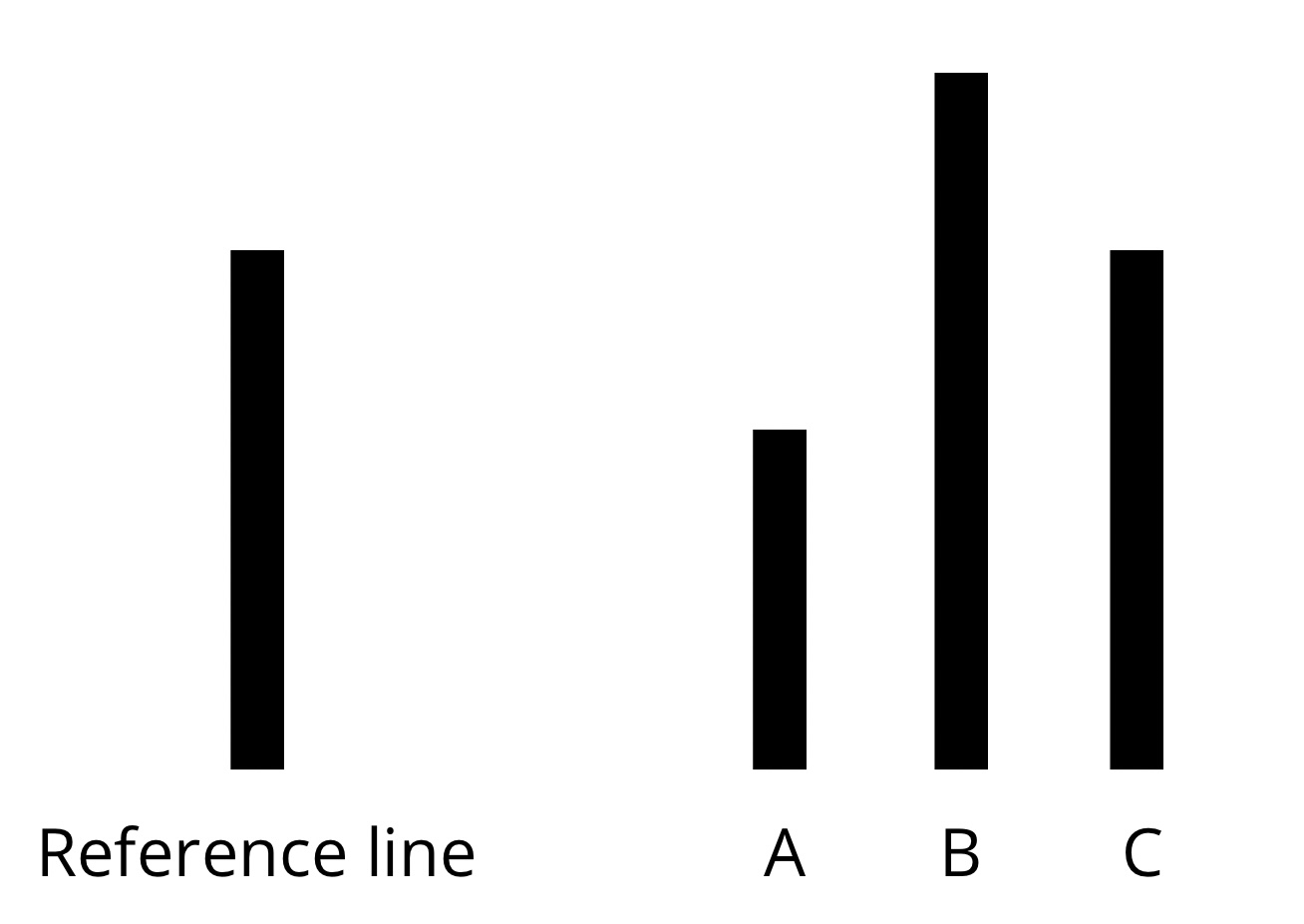
But here’s the catch: all but one of the men were actors who had been instructed to give the same wrong answer on certain trials. The goal was to see whether the one real participant would go along with the group. And, remarkably, most did. Seventy-four percent of participants conformed and gave the obviously wrong answer at least once.
Asch’s findings were a sobering look at how easily social pressure can override truth. As he put it, “That intelligent, well-meaning young people are willing to call white black is a matter of concern.” (Which was perhaps a bit of an understatement, given today’s era of misinformation.)
But it was Asch’s follow-up experiments that really stayed with me, and the reason I’m writing this piece at all. In his next set of experiments, Asch added a single “true partner” (someone who gave the correct answer), and conformity dropped dramatically. In this scenario, only 5% of participants conformed.
That’s what gives me hope.
Because lately, it feels like we’re living through our own version of Asch’s experiment. It feels like everyone is calling white, black. Facts are drowned out by propaganda. Outlets like Fox News convince millions of Americans to believe objectively false information. The president lies shamelessly and faces little pushback every single day.
And I’ll admit, I’ve felt a deep sense of hopelessness about how impossible the fight for truth feels. Because truth and facts are inconvenient. They’re messy, nuanced, and rarely black and white. Lies, on the other hand, are simple. It’s easy to say that grocery prices are down, that wars have ended, that Democrats are terrorists, that crime is falling in cities where the National Guard has been deployed, that ICE is only apprehending criminals, that Tylenol causes autism, that vaccines are the problem, and on and on.
Sometimes the fight for truth feels futile, like one honest voice can’t possibly cut through all the noise.
But Asch’s research suggests otherwise. It only takes one person refusing to go along with the lie to make it safer for others to do the same. It only takes one person choosing facts over propaganda.
Asch’s experiments don’t explain everything, of course. The reasons so many people today are embracing lies over truth, or staying quiet, are complex and include things like fear, identity, loyalty, and exhaustion. But the principle still holds: one honest voice can change what others believe is acceptable and possible to say out loud.
So if you’ve been feeling like I have lately, like you’re shouting into the void and wondering whether any of it still matters, it does matter. Someone is watching you choose truth over conformity, and your voice might just be the one that helps them find their own.
For more content like this (but in bite-sized video format), head over to my TikTok (@Dysregulation.Nation), YouTube, and Instagram (@DysregulationNation).
And, as always — stay calm, stay connected, and stay regulated.
—Brianna